


esigning and delivering industrial plants in Brazil requires a clear understanding of project delivery models, local regulations, engineering standards, and execution risks. For international companies planning industrial investments in the country, choosing between EPC (Engineering, Procurement and Construction) and EPCM (Engineering, Procurement and Construction Management) is a critical strategic decision.
This article explains how industrial plants are typically designed in Brazil and compares EPC and EPCM models, highlighting advantages, limitations, and best-fit scenarios for each approach.
.webp)
Industrial plant design in Brazil: general context
Brazil hosts complex industrial projects across sectors such as pharmaceuticals, food and beverage, chemicals, paper and pulp, mining, and data centers. Industrial plant design in the country is shaped by:
- Local regulatory requirements
- National technical standards
- Regional supply chain constraints
- Logistics and infrastructure challenges
- Workforce availability and site conditions
Because of this, industrial projects benefit significantly from local engineering expertise combined with international standards.
.webp)
The EPC model in Brazil
What is EPC?
Under the EPC model, a single contractor is responsible for the entire project lifecycle, including engineering, procurement, construction, installation, and often commissioning. The client signs one contract and transfers most execution risks to the EPC contractor.
Key characteristics
- Single point of responsibility
- Fixed or lump-sum contracts
- Defined scope, schedule, and cost
- Strong integration between engineering and construction
Advantages of EPC in Brazil
- Reduced interface risks
- Greater cost and schedule predictability
- Faster execution for fast-track projects
- Ideal for clients with limited local presence
Challenges
- Less flexibility for scope changes
- Higher upfront cost due to risk allocation
- Requires a highly experienced EPC contractor
In Brazil, EPC is commonly used for pharmaceutical plants, industrial expansions, modular facilities, and time-sensitive projects.
.webp)
The EPCM model in Brazil
What is EPCM?
In the EPCM model, the contractor acts as a project manager and engineering authority, while procurement and construction contracts are held directly by the client. The EPCM contractor manages interfaces, schedules, budgets, and quality on behalf of the owner.
Key characteristics
- Engineering and management-focused role
- Client holds contracts with suppliers and contractors
- Greater transparency in costs
- Flexible execution strategy
Advantages of EPCM in Brazil
- Cost optimization through competitive procurement
- Greater control over suppliers and contractors
- Flexibility for complex or evolving scopes
- Suitable for owners with strong project teams
Challenges
- Higher interface and coordination risk
- Greater demand on client-side management
- Longer decision-making cycles
EPCM is often chosen for large-scale industrial complexes, brownfield projects, and multi-phase developments in Brazil.
.webp)
EPC vs EPCM: which model is best?
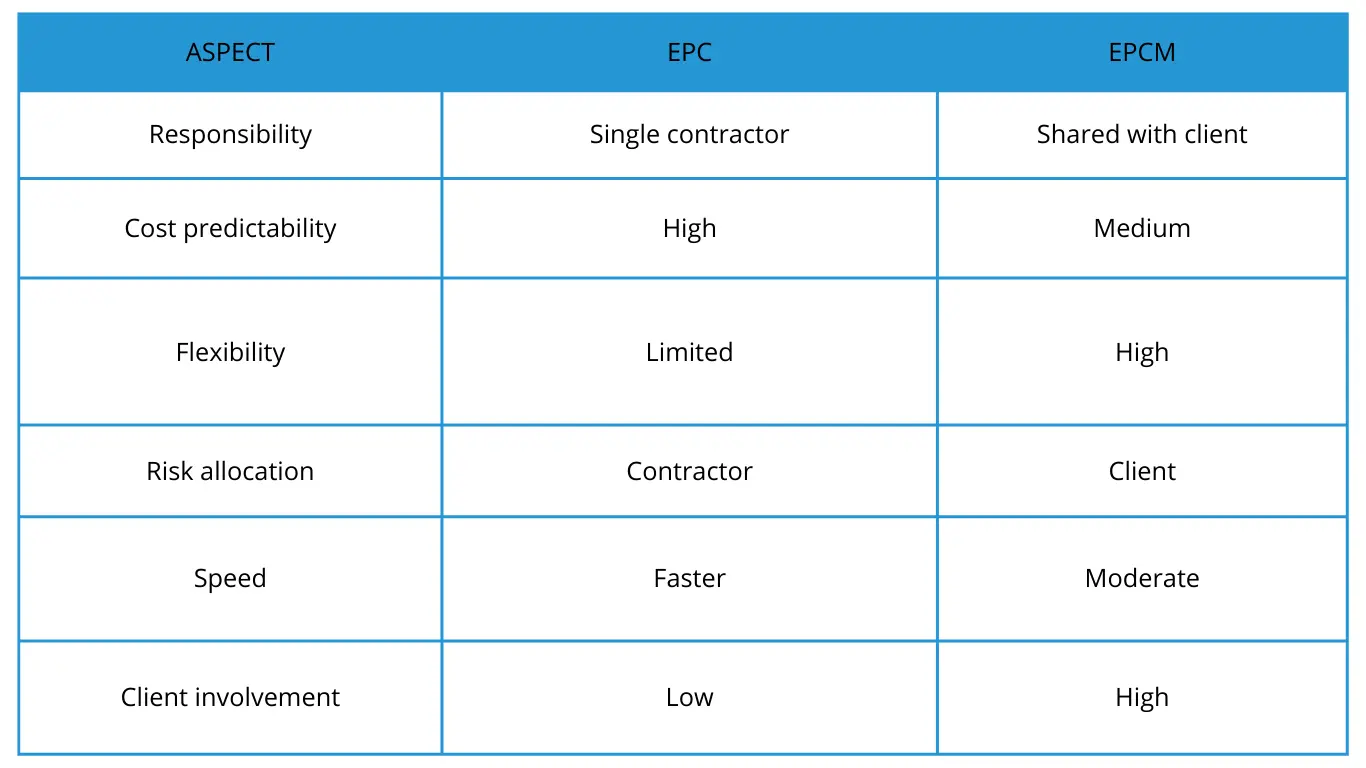
There is no universal solution. The choice depends on project size, complexity, schedule constraints, risk tolerance, and the client’s internal capabilities.
.webp)
The role of local engineering expertise
Regardless of the delivery model, local engineering knowledge is essential. Brazilian regulations, permitting processes, labor laws, and logistics conditions require experienced local teams that understand how to integrate international standards with national requirements.
Successful projects often combine:
- International engineering concepts
- Local design adaptation
- Integrated construction planning
- Strong interface management
Industrial plant design in Brazil demands strategic decisions from the earliest project stages. Understanding the differences between EPC and EPCM models allows investors and industrial owners to select the most suitable approach for their goals.
Whether opting for EPC or EPCM, partnering with an experienced Brazilian industrial engineering company is a decisive factor in achieving cost efficiency, schedule reliability, and long-term operational success.
Destaques
Instalações para data center em 15 etapas: do projeto ao first power

Ciclo de Palestras MSE: os novos caminhos do setor elétrico
MSE integra obras do laboratório Sirius
Mais posts de
Inovação


